SSC CGL 2026 Tier I · 8 Oct 2026 question paper with solutions
The SSC CGL 2026 Tier I paper held on 8 October 2026. Below are 10 of its 100 questions with answers and solutions. Attempt the full paper with a real exam timer, detailed analysis and an all-India rank on ExamEdge.
Exam date
8 October 2026
Questions
100
Marks
200
Time
60 min
Negative marking
−0.5 per wrong
Language
English
Paper pattern
General Intelligence and Reasoning
25 Q · 50 marks
General Awareness
25 Q · 50 marks
Quantitative Aptitude
25 Q · 50 marks
English Comprehension
25 Q · 50 marks
Source: Staff Selection Commission.
Sample questions with answers (10 of 100)
Q1 · General Intelligence and Reasoning · Number series – multiplication
What is the next number in the series? 2, 10, 50, 250, ?
A
1000
B
1100
C
1220
D
1250
Answer: D
Solution
Each term is multiplied by 5.
2×5=10, 10×5=50, 50×5=250, 250×5=1250.
Answer: 1250
Q2 · General Awareness · Sports – equipment
Which of the following sports includes a ball?
A
Boxing
B
Badminton
C
Chess
D
Golf
Answer: D
Solution
Golf is played with a small ball hit by clubs.
• Boxing uses gloves, badminton uses a shuttlecock, and chess uses pieces on a board – none uses a ball.
Answer: Golf
Q3 · Quantitative Aptitude · Profit and loss
A man sold two articles for ₹ 850 each. On one article, he earns a profit of 25% and on the other article, he suffers a loss of 15%. What is his overall profit ?
A
₹ 30
B
₹ 25
C
₹ 20
D
₹ 22
Answer: C
Solution
CP of first = 850 ÷ 1.25 = ₹680 → profit ₹170.
CP of second = 850 ÷ 0.85 = ₹1000 → loss ₹150.
Overall profit = 170 − 150 = ₹20.
Answer: ₹ 20
Q4 · English Comprehension · Fill in the blank – vocabulary
Directions (76-80): Read the following passage carefully and fill in the blanks with the most appropriate word from the given alternatives. In an age increasingly enamored of instantaneous information, intellectual restraint has become an almost antiquated virtue. The contemporary reader is perpetually assailed by a prodigious volume of claims, conjectures, and polemics, many of which acquire an unwarranted aura of credibility merely through repetition. What is particularly disquieting is not the sheer abundance of information but the gradual erosion of the cognitive habits required to interrogate it. A proposition that ought to invite scrutiny is instead accepted with remarkable alacrity, while evidence that complicates an established conviction is frequently dismissed as an inconvenient (1)________. This tendency is exacerbated by digital platforms whose algorithms are designed less to cultivate discernment than to maximise engagement. By continuously presenting users with material consonant with their pre-existing preferences, such systems can create an epistemic environment that is deceptively (2)________. Within such an environment, disagreement is no longer perceived as an opportunity for intellectual refinement but as an affront to one’s identity. Consequently, individuals become increasingly (3)________ to information that unsettles their assumptions, even when such information is supported by cogent evidence. The predicament is further complicated by the proliferation of ostensibly authoritative voices whose expertise is difficult to verify. Eloquence, confidence, and rhetorical dexterity are often mistaken for substantive knowledge, allowing specious arguments to acquire an appearance of legitimacy. The resulting confusion is not merely (4)________; it can have tangible consequences when poorly examined claims influence public policy, medical decisions, or collective perceptions of social reality. The remedy, therefore, cannot consist simply in accumulating more information. What is required is a deliberate cultivation of intellectual habits that enable individuals to distinguish the plausible from the demonstrable, the persuasive from the (5)________, and the familiar from the genuinely verifiable. In an informational ecosystem increasingly saturated with noise, scepticism—properly understood not as cynical disbelief but as disciplined inquiry—may be among the most indispensable forms of intellectual hygiene. Fill in Blank 1.
A
exculpation
B
cavil
C
imputation
D
salience
Answer: B
Solution
"Cavil" means a petty or trivial objection. Evidence that challenges a belief is dismissed as an inconvenient quibble.
• Exculpation = freeing from blame; imputation = accusation; salience = prominence – none fits "dismissed as".
Answer: cavil
Q5 · General Intelligence and Reasoning · Cause and effect
Vegetable prices have suddenly gone up in the market. What is the likely cause?
A
Sellers want to earn high profit margins only now
B
People have stopped eating other food items now
C
Vegetable supply has reduced greatly
D
Prices are always highest in the winter season now
Answer: C
Solution
A sudden price rise in a market is usually explained by demand–supply: when supply falls sharply (e.g., crop damage, transport disruption), prices jump.
• The other options are extreme or unsupported claims ("only now", "always").
Answer: Vegetable supply has reduced greatly
Q6 · General Awareness · Asian Games – hosts
Which of the following countries never hosted the Asian Games till 2022?
A
Pakistan
B
South Korea
C
China
D
Japan
Answer: A
Solution
Pakistan has never hosted the Asian Games.
• South Korea (1986 Seoul, 2002 Busan, 2014 Incheon), China (1990 Beijing, 2010 Guangzhou, 2022 Hangzhou) and Japan (1958 Tokyo, 1994 Hiroshima) have all hosted.
Answer: Pakistan
Q7 · Quantitative Aptitude · Mensuration – rectangle and square
The perimeter of a rectangular field is 52 meters, and the difference between its length and its breadth is 10 meters. What is the side length of a square whose area is exactly equal to the area of this rectangular field?
A
10 meters
B
12 meters
C
14 meters
D
16 meters
Answer: B
Solution
l + b = 52 ÷ 2 = 26 and l − b = 10 → l = 18, b = 8.
Area = 18 × 8 = 144 m².
Square side = √144 = 12 m.
Answer: 12 meters
Q8 · English Comprehension · Fill in the blank – vocabulary
Directions (76-80): Read the following passage carefully and fill in the blanks with the most appropriate word from the given alternatives. In an age increasingly enamored of instantaneous information, intellectual restraint has become an almost antiquated virtue. The contemporary reader is perpetually assailed by a prodigious volume of claims, conjectures, and polemics, many of which acquire an unwarranted aura of credibility merely through repetition. What is particularly disquieting is not the sheer abundance of information but the gradual erosion of the cognitive habits required to interrogate it. A proposition that ought to invite scrutiny is instead accepted with remarkable alacrity, while evidence that complicates an established conviction is frequently dismissed as an inconvenient (1)________. This tendency is exacerbated by digital platforms whose algorithms are designed less to cultivate discernment than to maximise engagement. By continuously presenting users with material consonant with their pre-existing preferences, such systems can create an epistemic environment that is deceptively (2)________. Within such an environment, disagreement is no longer perceived as an opportunity for intellectual refinement but as an affront to one’s identity. Consequently, individuals become increasingly (3)________ to information that unsettles their assumptions, even when such information is supported by cogent evidence. The predicament is further complicated by the proliferation of ostensibly authoritative voices whose expertise is difficult to verify. Eloquence, confidence, and rhetorical dexterity are often mistaken for substantive knowledge, allowing specious arguments to acquire an appearance of legitimacy. The resulting confusion is not merely (4)________; it can have tangible consequences when poorly examined claims influence public policy, medical decisions, or collective perceptions of social reality. The remedy, therefore, cannot consist simply in accumulating more information. What is required is a deliberate cultivation of intellectual habits that enable individuals to distinguish the plausible from the demonstrable, the persuasive from the (5)________, and the familiar from the genuinely verifiable. In an informational ecosystem increasingly saturated with noise, scepticism—properly understood not as cynical disbelief but as disciplined inquiry—may be among the most indispensable forms of intellectual hygiene. Fill in Blank 2.
A
congruous
B
refractory
C
pellucid
D
censorious
Answer: A
Solution
"Congruous" means in agreement or harmony. Algorithms feed users material consonant with their preferences, so the environment seems deceptively harmonious and consistent.
• Refractory = stubborn; pellucid = clear; censorious = severely critical.
Answer: congruous
Q9 · General Intelligence and Reasoning · Figure series – line pattern
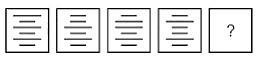
In the following figure series, select the figure which can be placed at the sign of question mark (?) from the given alternatives.
A

B

C

D

Answer: A
Solution
Read each figure's six lines top to bottom as Long (L) / Short (S):
• Fig 1: L S L S L S
• Fig 2: S S L S L S (line 1 toggled)
• Fig 3: S L L S L S (line 2 toggled)
• Fig 4: S L S S L S (line 3 toggled)
Next, line 4 toggles: S L S L L S, which is option (a).
Answer: Option (a)
Q10 · General Awareness · Biosphere reserves
Which of the following is not a function of biosphere reserves?
A
Cultural heritage preservation
B
Conservation of biodiversity
C
Promotion of monoculture farming
D
Sustainable development of local communities
Answer: C
Solution
Biosphere reserves (UNESCO MAB) aim at biodiversity conservation, sustainable development of local communities and support for research and cultural heritage.
Monoculture farming reduces diversity, so promoting it is not a function.
Answer: Promotion of monoculture farming
90 more questions in this paper
Take the full paper in the real exam interface, then see your score, section-wise analysis, solutions to every question and your all-India rank.
Topics in this paper
Direct and indirect speech
6 questions
Fill in the blank – vocabulary
5 questions
Para jumbles
3 questions
Statement and assumptions
2 questions
Statement and arguments
2 questions
Trigonometric identities
2 questions
Idioms
2 questions
Active and passive voice
2 questions
Spelling
2 questions
Number series – differences
2 questions
Address matching
2 questions
Blood relations
2 questions
CI and SI – rate
1 question
Cause and effect
1 question
Antonyms
1 question

ExamEdge
Mock tests, previous year papers and analysis for SSC, Banking, Railways, Teaching and Defence exams
Sharma Niwas, Ward No. 04, Ramjanki Mandir Road
Bhawanipur, Adapur Block, Raxaul
Purbi Champaran, Bihar 845301, India
© 2026 ExamEdge. All rights reserved. · Udyam Reg. No. UDYAM-BR-11-0126909
Payments are processed securely by Cashfree Payments
 ExamEdge