SSC CGL 2026 Tier I · 14 Oct 2026 question paper with solutions
The SSC CGL 2026 Tier I paper held on 14 October 2026. Below are 10 of its 100 questions with answers and solutions. Attempt the full paper with a real exam timer, detailed analysis and an all-India rank on ExamEdge.
Exam date
14 October 2026
Questions
100
Marks
200
Time
60 min
Negative marking
−0.5 per wrong
Language
English
Paper pattern
General Intelligence and Reasoning
25 Q · 50 marks
General Awareness
25 Q · 50 marks
Quantitative Aptitude
25 Q · 50 marks
English Comprehension
25 Q · 50 marks
Source: Staff Selection Commission.
Sample questions with answers (10 of 100)
Q1 · General Intelligence and Reasoning · Figure Series – Completion
Select an appropriate figure from the four options that would complete the figure.
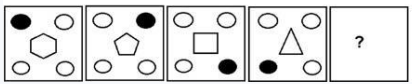
A
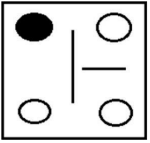
B
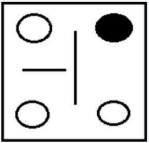
C
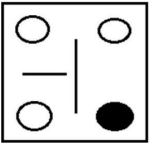
D
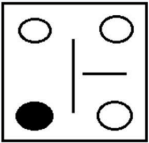
Answer: A
Solution
Two changes happen at each step:
• The central shape loses one side: hexagon (6) → pentagon (5) → square (4) → triangle (3) → two lines (2).
• The black circle moves one corner clockwise: TL → TR → BR → BL → back to TL.
Option (a) has two line segments in the centre and the black circle at the top-left.
Answer: Option (a)
Q2 · General Awareness · Geography – Plate Tectonics
Which of the following statements best explains how the Theory of Plate Tectonics provides a comprehensive framework for understanding the distribution of earthquakes, volcanoes, and mountain-building processes across the Earth's surface?
A
Plate tectonics explains crustal deformation exclusively at convergent boundaries, with no significant tectonic activity observed along divergent or transform boundaries.
B
The movement of lithospheric plates over the asthenosphere is driven by slab pull, ridge push, and mantle convection currents, leading to varied geological phenomena like ocean trench formation, rift valleys, and fault lines.
C
The Himalayas were formed by oceanic-continental convergence, resulting in subduction and volcanic mountain formation along the Indo-Gangetic Plain.
D
Plate tectonics states that major tectonic activity is confined to oceanic crust, while continental plates are geologically stable and unaffected by internal earth processes.
Answer: B
Solution
Lithospheric plates move over the asthenosphere, driven by slab pull, ridge push and mantle convection. This explains trenches, rift valleys, faults, earthquakes and volcanoes along all types of plate boundary.
(a) and (d) are wrong. (c) is wrong because the Himalayas formed from a continental–continental collision, not oceanic subduction.
Answer: The movement of lithospheric plates over the asthenosphere is driven by slab pull, ridge push, and mantle convection currents, leading to varied geological phenomena like ocean trench formation, rift valleys, and fault lines.
Q3 · Quantitative Aptitude · Coordinate Geometry – Area of triangle
Find the area of a triangle whose vertices are (a, b +c), (a, b - c) and (- a, c).
A
2b (a + c)
B
c (a-b)
C
2bc
D
2ac
Answer: D
Solution
(a, b + c) and (a, b − c) lie on the line x = a, so that side has length 2c.
The third point (−a, c) is 2a away from that line.
Area = ½ × 2c × 2a = 2ac.
Answer: 2ac
Q4 · English Comprehension · Spelling
Select the correctly spelt word.
A
Sacreligious
B
Sacriligious
C
Sacrilegious
D
Sacrelegious
Answer: C
Solution
The correct spelling is 'sacrilegious' (from 'sacrilege'), even though people often confuse it with 'religious'.
Answer: Sacrilegious
Q5 · General Intelligence and Reasoning · Figure Series – Movement in sectors
Find the one which completes the series.

A
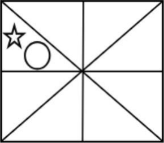
B
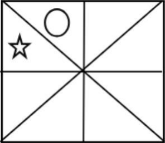
C
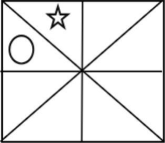
D
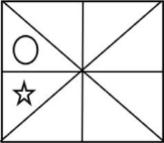
Answer: A
Solution
Each box is split into 8 triangular sectors.
• The star moves one sector anticlockwise each step: right-upper → top-right → top-left → next is left-upper.
• The circle moves one sector clockwise each step: bottom-right → bottom-left → left-lower → next is left-upper.
So both the star and the circle are in the left-upper sector, as in option (a).
Answer: Option (a)
Q6 · General Awareness · Government Schemes – PM Dhan-Dhaanya Krishi Yojana
Consider the following statements regarding the implementation and monitoring of the Prime Minister Dhan-Dhaanya Krishi Yojana: 1. The State Dhan Dhaanya Krishi Yojana Samiti is headed by the Chief Secretary. 2. The National Monitoring Committee is headed by the Secretary, Department of Agriculture and Farmers Welfare. 3. District performance on output indicators is ranked monthly through the Prime Minister Dhan-Dhaanya Krishi Yojana dashboard. Which of the statements given above are correct?
A
1 and 2 only
B
2 and 3 only
C
1 and 3 only
D
1, 2 and 3
Answer: D
Solution
PM Dhan-Dhaanya Krishi Yojana (approved in 2025) covers 100 low-productivity districts by bringing 36 schemes together.
According to the key, it is monitored at three levels:
• a state committee under the Chief Secretary
• a national committee under the Agriculture Secretary
• monthly ranking of districts on a dashboard
Answer: 1, 2 and 3
Q7 · Quantitative Aptitude · Pipes & Cisterns
Pipe A can fill a tank in 6 hours, pipe B can fill the same tank in 30 hours and pipe C can fill the same tank in 20 hours. The time taken (in hours) by them to fill one-fourth of the same tank if they operate together is:
A
2
B
4
C
3
D
1
Answer: D
Solution
Combined rate = 1/6 + 1/30 + 1/20 = (10 + 2 + 3)/60 = 1/4 of the tank per hour.
So one-fourth of the tank fills in 1 hour.
Answer: 1
Q8 · English Comprehension · Para Jumbles
The following sentences, when rearranged in the proper order, form a coherent paragraph. Select the correct sequence. P. Yet the very technology that enabled this unprecedented access has simultaneously fragmented our attention into ever smaller and more restless units. Q For the greater part of human history, knowledge was a scarce commodity, jealously guarded by monasteries, guilds and a handful of universities. R. The printing press, and centuries later the internet, democratised this hoarded wisdom beyond the wildest imagination of the medieval scribe. S. Consequently, we now find ourselves drowning in information while remaining curiously starved of genuine understanding.
A
Q-R-P-S
B
R-Q-S-P
C
Q-P-R-S
D
P-R-Q-S
Answer: A
Solution
• Q introduces knowledge as scarce in the past.
• R: the press and the internet made it available to all.
• P: 'Yet' the same technology fragmented our attention.
• S: 'Consequently' we are drowning in information.
Answer: Q-R-P-S
Q9 · General Intelligence and Reasoning · Letter Analogy – Coding
MKPT is related to QOTX in a certain way based on the English alphabetical order. In the same way, ENSU is related to IRWY. To which of the following is DHGR related, following the same logic?
A
HLKV
B
HDRG
C
FJIT
D
QEIY
Answer: A
Solution
Each letter moves +4: M→Q, K→O, P→T, T→X. (Check: ENSU → IRWY.)
DHGR → D+4 = H, H+4 = L, G+4 = K, R+4 = V → HLKV.
Answer: HLKV
Q10 · General Awareness · Modern History – Labour Legislation
The Factories Act of 1881 is often criticized for being more aligned with British economic interests than Indian labor welfare. Which of the following provisions supports this interpretation?
A
It introduced mandatory weekly holidays and daily work-hour limits for all factory workers.
B
It prohibited child labor under the age of 14 and regulated adult working hours
C
It imposed restrictions only on children, without addressing the working conditions of adult laborers.
D
It ensured minimum wages and union rights for factory workers across British India.
Answer: C
Solution
The Factories Act of 1881 only protected children: it banned children under 7 and limited hours for children aged 7–12. It did nothing for adult workers.
It was pushed partly by Lancashire mill owners who wanted to blunt cheap Indian competition, so it served British interests more than Indian workers.
Answer: It imposed restrictions only on children, without addressing the working conditions of adult laborers.
90 more questions in this paper
Take the full paper in the real exam interface, then see your score, section-wise analysis, solutions to every question and your all-India rank.
Topics in this paper
Cloze Test
3 questions
Spelling
3 questions
Current Affairs – Appointments (2026)
3 questions
Articles
3 questions
Art & Culture – Folk Dances
2 questions
Para Jumbles
2 questions
Statement & Course of Action
2 questions
Data Interpretation – Bar graph
2 questions
Antonyms
1 question
Clerical Comparison – Addresses
1 question
Algebra – x² + 1/x²
1 question
Active & Passive Voice – Modal
1 question
Cloze Test – Conditionals
1 question
Cloze Test – Conjunctions
1 question
Algebra – Surds
1 question

ExamEdge
Mock tests, previous year papers and analysis for SSC, Banking, Railways, Teaching and Defence exams
Sharma Niwas, Ward No. 04, Ramjanki Mandir Road
Bhawanipur, Adapur Block, Raxaul
Purbi Champaran, Bihar 845301, India
© 2026 ExamEdge. All rights reserved. · Udyam Reg. No. UDYAM-BR-11-0126909
Payments are processed securely by Cashfree Payments
 ExamEdge